

Index
- Quick comparison: the best hair dye fixatives for home use
- What are dye fixing agents and how do they work?
- The 5 best fabric dye fixatives rated
- Natural fabric fixatives: salt, vinegar, and eco-friendly alternatives
- How to fix color after dyeing: a step-by-step method
- Fixing Cotton Color: Specific Tips for Cellulose Fibers
- Common Mistakes and How to Fix Them: Troubleshooting Homemade Hair Dye
- Sustainability and safety certifications: what to look for on labels
Last updated: August 2, 2026
Choosing the best dye fixatives for fabric dyes is the difference between a color that lasts for years and one that fades after the third wash. Aybel has helped thousands of DIY enthusiasts achieve professional results at home. The short answer: there's no single, universal fixative. The choice depends on the type of fiber, the dye used, and the intended use of the garment. This guide covers the criteria for orientation, a concrete evaluation of the best products available in Italy in 2026, a comparison of natural and synthetic fixatives, and a step-by-step method for applying fixative correctly.
Quick Comparison: Best Fabric Dye Fixing Agents for Home Use
| Product | Best for | Application method | Home use |
|---|---|---|---|
| Aybel Fiske | General dyeing, cotton and natural fibers | Hand or washing machine | Yes |
| Rayher Fixative | Post-dyeing with washing machine dyes | Hand | Yes |
| Pebeo Setacolor | Decoration with colors on fabric | Iron or oven | Yes |
| Marabu Fashion Spray | Spray, stencil, batik effects | Spray + iron | Yes |
| Gammafix | Laboratories and professional use | Industrial finishing | No |
For those who dye at home, the first four options cover practically every need.
What are dye fixing agents and how do they work?
A textile dye fixative is a chemical auxiliary that increases the color fastness of fibers by reducing dye migration during washing, exposure to light, and contact with perspiration. Without a fixative, many dyes remain superficially attached to the fiber, causing rapid fading and staining of the rinse water.
Mechanism of action on textile fibres
The fixative works by creating a chemical bond between the dye molecules and the polymer chains of the fiber. In reactive dyes on cotton, the process exploits the formation of covalent bonds between the reactive group of the dye and the hydroxyl groups of cellulose. In direct dyes , the fixative introduces cationic resins that form a protective layer around the fiber, reducing the solubility of the dye in water.
Fixatives with formaldehyde vs. formaldehyde-free
Historically, the most effective fixatives were based on polyamide condensates with formaldehyde. Today, the European Union's REACH Regulation severely limits the use of formaldehyde in consumer textile products. According to the European Chemicals Agency (ECHA) , formaldehyde is classified as a Category 1B carcinogen.
Modern formaldehyde-free fixatives, based on cationic resins and acrylic polymers, achieve comparable or superior performance. For home use, choosing a formaldehyde-free product is both a safe and regulatory choice.
The 5 best fabric dye fixatives rated
1. Aybel Fiske: The fixative for those who dye at home
Aybel Fiske is the most comprehensive choice for those who dye fabrics at home. It works both in the tub and in the washing machine, is suitable for cotton, silk, wool, and other natural fibers, and is designed for garments subject to frequent washing or direct sunlight.
Best for: crafters, hobbyists, anyone who dyes at home and wants long-lasting, vibrant colors.
2. Rayher Fixative: compact and accessible
Rayher fixative is designed to complement laundry dyes. The 50 ml bottle is convenient for those who dye occasionally. It works well as a standard post-treatment, improving color brilliance and wash resistance. For a hobbyist who dyes two or three garments a year, it's more than sufficient.
3. Pebeo Setacolor: hot fix for decorative colors
Pebeo Setacolor is a fabric paint system that requires heat to stabilize the pigment on the fiber. Fixation is achieved by ironing for 5 minutes or baking at 150°C for 5 minutes.
4. Marabu Fashion Spray: for spray and stencil effects
Marabu Fashion Spray is a water-based, odorless, and lightfast spray paint designed for creative applications on light-colored fabrics with up to 20% synthetic fibers. The resulting paint is soft to the touch and washable up to 40°C after heat setting. It only works on light-colored backgrounds and always requires a heat treatment to ensure durability.
5. Gammafix and professional solutions for laboratories
Gammafix is a product designed for textile companies and professionals. Available in various formulations, including low-formaldehyde formulations, it improves the resistance to washing, sweat, and rubbing on all types of fibers. It is not available for retail purchase and is sold by quote, excluding home use.
Natural fabric fixatives: salt, vinegar, and eco-friendly alternatives
Many natural dye enthusiasts wonder if salt and vinegar can replace chemical fixatives. The answer depends on the dye and the fiber.
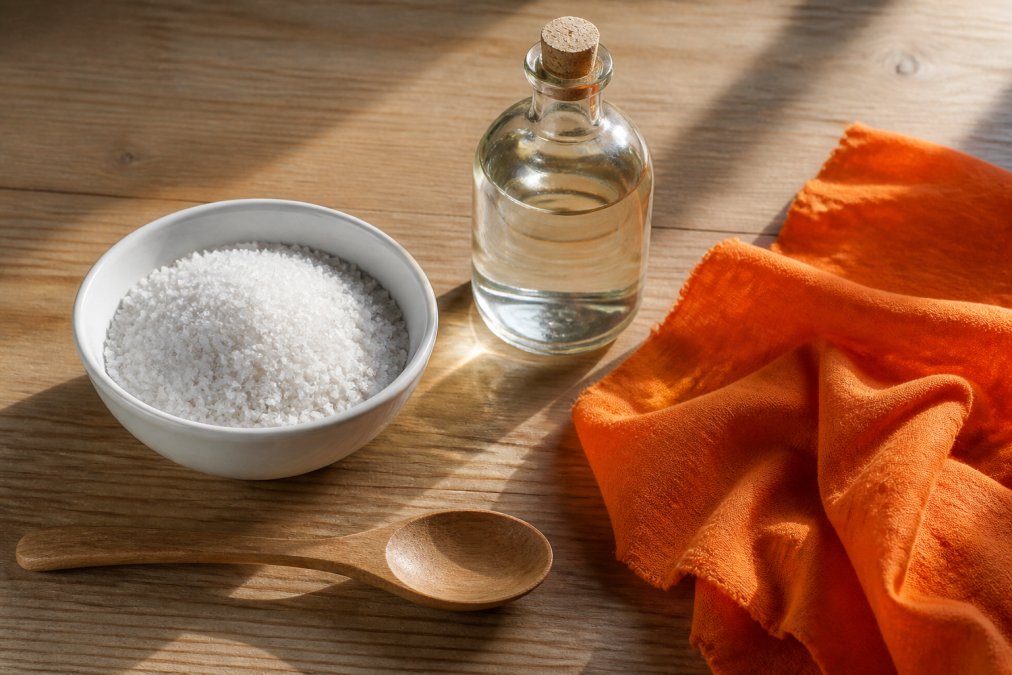
Comparison of natural and synthetic fixatives: when to choose which
Salt and vinegar are not equivalent to synthetic fixatives in terms of colorfastness. They function as processing aids; they don't create the stable chemical bond that a professional fixative guarantees.
| Criterion | Salt / Vinegar | Synthetic fixative |
|---|---|---|
| Fastness to washing | Average | High |
| Sweat fastness | Low | High |
| Ease of use | High | High |
| Environmental impact | Very low | Variable |
| Suitable for reactive dyes | No | Yes |
| Suitable for natural dyes | Yes | Yes |
For those using natural dyes on wool or silk in a traditional artisanal context, salt and vinegar are suitable solutions. For those dyeing cotton with synthetic dyes and seeking true wash fastness, a professional fixative is essential.
How to fix color after dyeing: a step-by-step method
Correct fixing is done immediately after the dyeing stage, before the final rinse. This is the time when the fibers are most receptive and the dye has not yet fully stabilized.
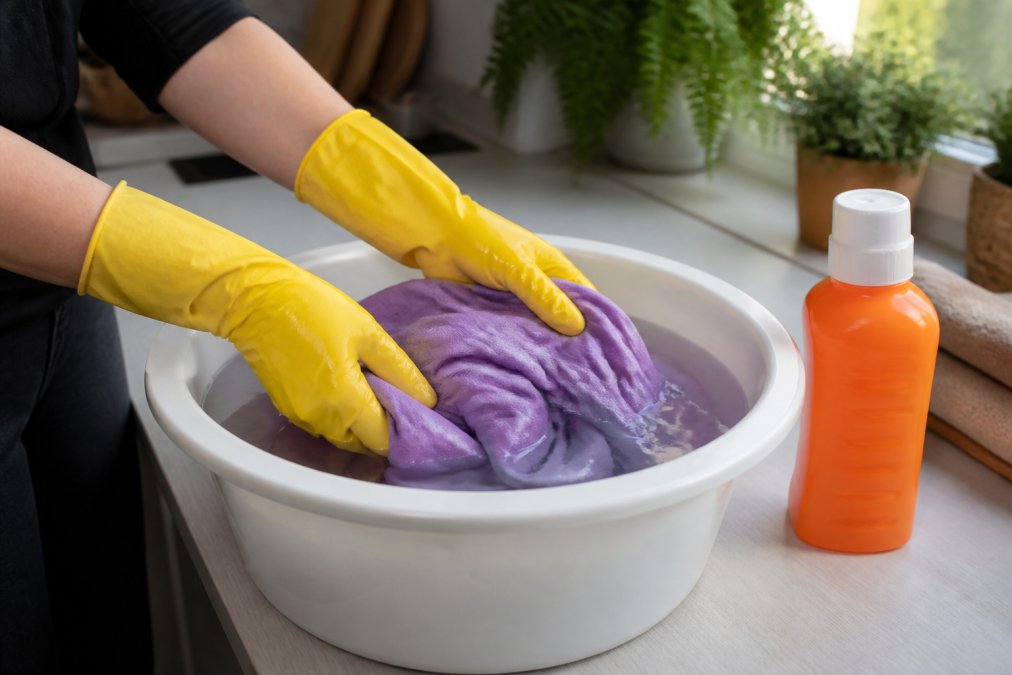
Hand application in a basin
- Prepare a bowl with lukewarm water, around 30-40°C.
- Add the fixative in the quantity indicated on the package.
- Immerse the still damp item and mix gently for 10-15 minutes.
- Leave to soak for the indicated time, usually 20-30 minutes.
- Rinse with cold water until the water runs almost clear.
- Lay the garment out in the shade and let it dry.
Never squeeze the garment forcefully while fixing: mechanical pressure can cause uneven dye migration.
Application in the washing machine
For those who use Aybel Fiske or washing machine compatible products:
- Place the freshly dyed garment, still damp, in the washing machine.
- Add Aybel Fiske to the detergent drawer or directly into the drum, following the product instructions.
- Set a delicate program at 30°C without spinning or with low spin speed.
- Once finished, hang the garment to dry immediately to avoid permanent creases.
Fixing Cotton Color: Specific Tips for Cellulose Fibers
Cotton is the most common fiber for home dyeing, but it presents greater challenges in terms of colorfastness. Cotton's cellulose structure is naturally hydrophilic: it absorbs water readily, which means it also absorbs dye well, but it releases it just as easily if the dye is not fixed properly.
To color-fix cotton with reactive dyes, the optimal process involves an alkaline bath during dyeing, followed by a hot soap wash and then the application of the fixative. This step removes excess unfixed dye before stabilizing the dye that is actually bound to the fiber.
Cotton treated correctly with a fixative maintains its color vividness and brilliance even after numerous washes. According to the technical guidelines of EURATEX - the European Textile and Clothing Confederation, wash fastness directly depends on the efficiency of the fixative process.
Common Mistakes and How to Fix Them: Troubleshooting Homemade Fabric Dye
Home dyeing almost always fails for the same reasons.
Uneven color or stains: The fabric must move constantly in the bath to ensure even distribution of the dye and fixative. A garment left still tends to absorb the dye unevenly.
Color fading quickly: This often means that the fixative was not applied, or was applied after rinsing prematurely. L correct order is: dye, fixative, rinse.
Color tone altered after fixing: Some cationic fixatives tend to darken shades slightly, especially on light colors. Always test the fixative on a scrap of fabric of the same color before treating the entire garment.
Color bleeding on laundry in the washing machine: This indicates that the fixing process hasn't been completed. The solution is to repeat the fixing process and wash the dyed garment separately for the first two or three washes.
Sustainability and safety certifications: what to look for on labels
For those who choose fixatives with health and environmental concerns in mind, label certifications are the most reliable guide.
GOTS (Global Organic Textile Standard): Guarantees compatibility with the processing of certified organic fabrics. GOTS-compliant fixatives must meet stringent limits on hazardous substances, including formaldehyde.
ZDHC (Zero Discharge of Hazardous Chemicals): An industry protocol that limits the use of hazardous chemicals throughout the textile supply chain.
bluesign: Certification that attests to product safety for consumers, workers, and the environment.
For domestic use, the main regulatory reference is the European Union's CLP Regulation. As indicated by the Italian Ministry of Health - Chemical Product Safety Data Sheets , every chemical product intended for the consumer must display legible hazard symbols, H phrases, and precautionary statements (P). A fixative without hazard symbols on the label, free of formaldehyde, and compliant with REACH regulations is the safest choice for those working at home.
Achieving long-lasting color on fabric requires the right product applied at the right time. Aybel Fiske is designed precisely for this purpose: it works by hand or in the washing machine, is suitable for cotton, silk, wool, and natural fiber blends, and is available in formats suitable for both those dyeing a single garment and those working on larger quantities. For those seeking personalized support in choosing the right color, Aybel also offers photo consultations. Discover Aybel and get brilliant, long-lasting colors from the first wash.
Frequently Asked Questions
What to use to fix the color on fabrics after dyeing?
Specialized dye fixatives, such as Aybel Fiske, are the most reliable choice for home use: they are applied in a basin or washing machine after dyeing and improve colorfastness to washing and rubbing. For reactive and direct dyes on natural fibers like cotton and silk, a specially formulated chemical fixative guarantees significantly superior results compared to home remedies like salt or vinegar.
Do salt and vinegar really help set color on fabrics?
Salt and vinegar are natural fabric fixatives with limited utility. Salt promotes dye breakdown during the dyeing process, while vinegar lowers the pH and can be helpful with acidic dyes on wool and silk. Neither forms the chemical cross-link that ensures true colorfastness after repeated washing. For long-lasting colorfastness, especially on cotton dyed with reactive dyes, a dedicated textile fixative is preferable.
How do you fix cotton color in the washing machine?
To color-fix cotton in the washing machine, add a fixative (such as Aybel Fiske, available in 225 ml or 1 liter bottles) to the drum or fabric softener compartment after dyeing and rinsing the garment. Set the garment to a cold or 30°C cycle without detergent. This step improves wet fastness and reduces the risk of color bleeding in subsequent washes. Repeat the treatment if the garment is washed very frequently.
What is the difference between formaldehyde-containing and formaldehyde-free fixatives?
Formaldehyde-based fixatives form highly stable chemical cross-links on fibers, but formaldehyde is classified as a substance of regulatory concern under the REACH Regulation (EC No. 1907/2006) and can cause irritation. Formaldehyde-free fixatives, such as new-generation cationic resins, now offer comparable performance in terms of fastness to washing and perspiration, without the associated risks. For home use, choosing formaldehyde-free products is recommended both for safety and to comply with textile certifications such as Oeko-Tex.
How to prevent home-dyed clothes from fading after just a few washes?
The most common causes of premature fading are: failure to use a fixing agent after dyeing, excessively hot wash water, and the use of harsh detergents. To prevent this, always apply a dedicated textile fixing agent immediately after dyeing, wash dyed garments at 30°C with delicate detergents, and turn the garment inside out before washing. If the color continues to fade, repeat the fixing treatment after 3-4 washes.
This article was written using GrandRanker